
Amylin Analog vs GLP-1 Agonist | Research Comparison
Cagrilintide vs Semaglutide
A mechanistic research comparison of cagrilintide (long-acting amylin analog, AMY1-3R) and semaglutide (GLP-1R agonist). How amylin receptor and GLP-1 receptor pathways differ, and why their combination — CagriSema — represents a distinct multi-mechanism research model.
Cagrilintide and semaglutide target entirely different receptor systems — amylin receptors vs GLP-1R — making them non-redundant and highly complementary for multi-pathway research. Cagrilintide is the primary tool for amylin receptor pharmacology research. Semaglutide is the GLP-1R baseline. Used together they model the dual-pathway mechanism of CagriSema, the combination currently in Phase 3 trials.
| Parameter | Cagrilintide | Semaglutide |
|---|---|---|
| Primary Receptor | AMY1R / AMY2R / AMY3R | GLP-1R |
| Receptor Family | Amylin / CGRP | Class B GPCR incretin |
| Native Hormone Analog | Amylin (IAPP) | GLP-1 |
| Half-Life | ~7 days | ~7 days |
| Fatty Acid | C18 (monoacid) | C18 (monoacid) |
| CNS Satiety Effect | Area postrema / NTS | Hypothalamus / VMH |
| Gastric Emptying | Moderate inhibition | Strong inhibition |
| Insulin Secretion | Indirect (amylin) | Direct GSIS potentiation |
| Glucagon Suppression | Moderate | Strong |
| Combination Synergy | CagriSema model | CagriSema model |
| Price | See price | See price |
| HPLC Purity | Not published | Not published |
Receptor Mechanism Comparison
Cagrilintide and semaglutide are mechanistically orthogonal — they target entirely different receptor systems with non-overlapping primary signaling cascades. Cagrilintide activates amylin receptors (AMY1R, AMY2R, AMY3R), which are heteromeric complexes of calcitonin receptor (CTR) and receptor activity-modifying proteins (RAMP1, RAMP2, RAMP3). Semaglutide activates GLP-1R, a class B GPCR in the glucagon receptor family. Neither compound has meaningful cross-reactivity at the other’s primary target.
This mechanistic orthogonality is the core scientific rationale for CagriSema (cagrilintide + semaglutide combination), which is currently in Phase 3 clinical trials. The hypothesis is additive or synergistic effects on signalling across amylin and incretin receptor families through non-competing pathways — a hypothesis that makes preclinical mechanistic investigation with these two separate compounds scientifically valuable.
Mechanistic note: Amylin receptors signal through cAMP (Gαs) and also couple to Gαi and β-arrestin pathways in a tissue-dependent manner. The CNS expression pattern of AMY1-3R (area postrema, nucleus tractus solitarius) overlaps partially with GLP-1R expression (hypothalamus, VMH) but the primary neural circuits activated are distinct — providing complementary rather than redundant CNS satiety signaling.
Amylin Receptor Pathway — Cagrilintide
Native amylin (islet amyloid polypeptide, IAPP) is co-secreted with insulin from pancreatic beta cells in response to nutrient ingestion. It activates AMY1-3R in the area postrema and NTS (nucleus tractus solitarius) to inhibit glucagon secretion, slow gastric emptying, and suppress appetite through brainstem circuits. Native amylin has a half-life of only ~10–20 minutes in plasma, making it impractical as a research tool for sustained receptor occupancy studies.
Cagrilintide addresses this via C18 fatty acid conjugation (identical linker chemistry to semaglutide), extending plasma half-life to ~7 days via reversible albumin binding. This allows sustained AMY1-3R occupancy in preclinical in vivo models and provides a long-acting amylin analog comparator for mechanistic studies where receptor kinetics need to be controlled. Lot-specific handling and stability information should be taken only from the applicable documentation and institutionally approved methods.
CagriSema Research Model
CagriSema is Novo Nordisk’s fixed-ratio combination of cagrilintide and semaglutide in Phase 3 trials (REDEFINE program). CagriSema combines an amylin analog and a GLP-1R agonist from non-overlapping receptor families, enabling controlled comparison of parallel signaling pathways.
For preclinical research groups investigating this combination mechanism, OligoPoly Laboratories supplies both compounds separately, allowing researchers to design their own concentration-response matrices and combination ratios rather than being constrained to a fixed clinical ratio.
Preclinical CagriSema Protocol Considerations
- Both compounds have extended half-lives suitable for comparative receptor-occupancy research
- Parallel single-agent arms (cagrilintide alone, semaglutide alone) are essential controls for attributing combination effects to individual receptor contributions
- Area postrema lesion models can selectively ablate amylin pathway contribution to isolate GLP-1R-mediated effects
- GLP-1R knockout models can isolate amylin receptor contribution
Compound Selection
Choose Cagrilintide for: pure amylin receptor pharmacology, AMY1-3R occupancy studies, brainstem-specific satiety circuit research, or as the amylin component in CagriSema combination models.
Choose Semaglutide for: GLP-1R baseline studies, incretin pharmacology, or as the GLP-1 component in combination models.
Use both together when modelling the CagriSema dual-pathway mechanism or when you need to dissect individual receptor contributions to a combination effect. For a three-compound metabolic panel, add Tirzepatide for the GLP-1R/GIPR dual agonist comparator — giving you single/dual/combination coverage of the incretin + amylin research space.
Research Use Only: All compounds are strictly for laboratory and in vitro research. Not for human use, veterinary use, or any diagnostic or treatment purpose. OligoPoly Laboratories supplies research-grade peptides exclusively to qualified researchers.
OligoPoly Laboratories — Houston TX · Research Use Only
Cagrilintide vs Semaglutide — Amylin vs GLP-1 Research Comparison
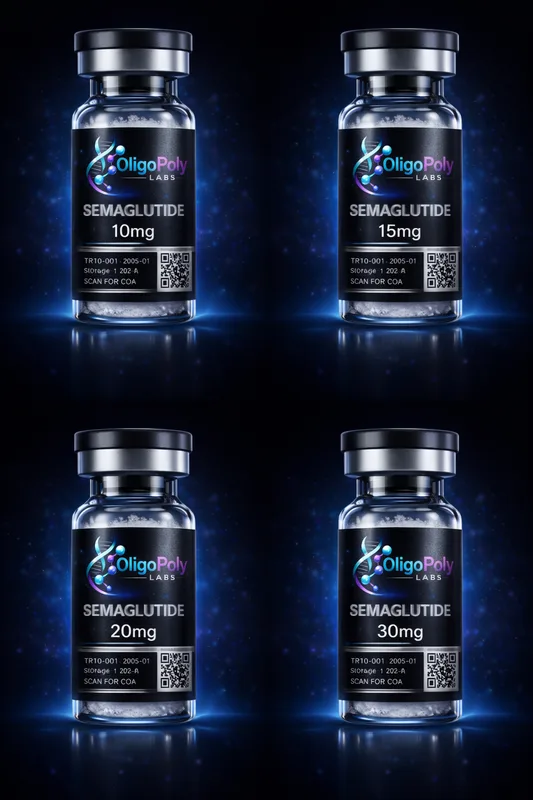
Cagrilintide and semaglutide target mechanistically orthogonal receptor systems — amylin receptors (AMY1-3R) and GLP-1R respectively — making them complementary rather than competing research compounds. Both have ~7-day plasma half-life via C18 fatty acid albumin binding. Together they model the dual-mechanism CagriSema combination currently in Phase 3 trials. OligoPoly Laboratories supplies cagrilintide (5mg, See price) and semaglutide (10mg, See price) for laboratory research use from Houston TX.
Research Use Only.
Single-Compound Research Materials Referenced in This Guide
For Research Use Only · Third-Party Tested · COA Documentation · Ships from Houston TX