Master Educational Pillar
PeptideScience
Everything researchers need to understand research peptides — from amino acid chemistry and receptor pharmacology to compound categories, quality testing, and laboratory protocols. The complete reference for peptide science.
What Are Peptides?
Peptides are short chains of amino acids linked together by peptide bonds — the same fundamental chemical architecture as proteins, but smaller. Where proteins are typically hundreds or thousands of amino acids long, peptides range from 2 to approximately 50 amino acids. This size range gives peptides distinct physicochemical properties: they are small enough to cross biological barriers and interact with specific receptor targets, yet large enough to carry biological information encoded in their sequence.
In the human body, thousands of naturally occurring peptides function as signaling molecules — hormones, neurotransmitters, growth factors, and immune regulators. Insulin is a peptide. GLP-1 (glucagon-like peptide-1) is a peptide. Oxytocin, vasopressin, and angiotensin are all peptides. The biological information contained in a peptide’s amino acid sequence, three-dimensional structure, and post-translational modifications (fatty acid conjugation, cyclization, phosphorylation) determines which receptors it binds and what cellular responses it triggers.
Amino Acids — The Building Blocks
All peptides are constructed from amino acids — organic molecules containing an amino group (–NH₂), a carboxyl group (–COOH), and a variable side chain (R group) that determines each amino acid’s chemical identity. There are 20 standard amino acids encoded by the genetic code, each with distinct properties: hydrophobic (valine, leucine, isoleucine), polar (serine, threonine, cysteine), acidic (aspartate, glutamate), basic (lysine, arginine, histidine), and aromatic (phenylalanine, tyrosine, tryptophan).
Amino acids are linked by peptide bonds — covalent bonds formed between the carboxyl group of one amino acid and the amino group of the next, releasing a water molecule. The resulting chain has directionality: an N-terminus (free amino group) and a C-terminus (free carboxyl group), which are critical for receptor binding specificity. The sequence of amino acids from N to C terminus is the primary structure of the peptide and is the foundation of its biological activity.
Synthetic Research Peptides
Research peptides are synthesized using Solid-Phase Peptide Synthesis (SPPS), a technique developed by R.B. Merrifield (Nobel Prize, 1984). In SPPS, amino acids are added sequentially to a resin-bound growing chain using protected building blocks under controlled chemical conditions. After synthesis, the peptide is cleaved from the resin, deprotected, and purified by High-Performance Liquid Chromatography (HPLC) to remove deletion sequences, truncations, and synthesis-related impurities. The final product — a lyophilized white powder — is verified by HPLC purity analysis and LC-MS molecular weight confirmation before use in research.
How Research Peptides Work
Research peptides exert their biological effects primarily through receptor binding — a highly specific interaction between the peptide molecule and a complementary receptor protein on or within target cells. This selectivity is the foundation of peptide pharmacology and is what makes research peptides valuable tool compounds for studying specific signaling pathways in isolation.
Receptor Binding Mechanism
Most research peptides act on G protein-coupled receptors (GPCRs) — a superfamily of membrane-bound proteins that transduce extracellular signals into intracellular responses. When a peptide (the ligand) binds to its target GPCR, it induces a conformational change in the receptor that activates intracellular G proteins. Different receptor subtypes couple to different G protein classes, producing distinct second messenger cascades (cAMP, IP₃/DAG, or ion channel modulation) that ultimately alter cellular gene expression, enzyme activity, or membrane potential.
Key Receptor Classes in Research Peptide Science
| Receptor Class | Signaling | Research Peptides | Pathway |
|---|---|---|---|
| GLP-1R (GLP-1 Receptor) | Gαs / ↑cAMP | Semaglutide, Tirzepatide, Retatrutide | Incretin, insulin secretion, satiety |
| GIPR (GIP Receptor) | Gαs / ↑cAMP | Tirzepatide, Retatrutide | Incretin amplification, adipose tissue |
| GCGR (Glucagon Receptor) | Gαs / ↑cAMP | Retatrutide | Energy expenditure, hepatic glucose, lipolysis |
| GHSR-1a (Ghrelin Receptor) | Gαq / IP₃ | Ipamorelin, GHRP-2/6 | GH secretion, appetite regulation |
| GHRHR (GHRH Receptor) | Gαs / ↑cAMP | CJC-1295, Tesamorelin | Pituitary GH release |
| AMY1-3R (Amylin Receptors) | Gαs / ↑cAMP | Cagrilintide | Satiety, gastric motility, glucagon suppression |
| IRR (Innate Repair Receptor) | JAK2/STAT5 | ARA-290 | Tissue protection, anti-inflammatory |
| Integrins / ECM receptors | FAK / MAPK | BPC-157, GHK-Cu | Cell migration, angiogenesis, ECM remodeling |
Molecular Interactions Beyond GPCR
Not all research peptides act exclusively on GPCRs. BPC-157 modulates VEGF receptor signaling and nitric oxide synthase activity through interactions with growth factor pathway components. GHK-Cu (copper tripeptide) interacts with matrix metalloproteinases and integrin receptors in the extracellular matrix. TB-500 (Thymosin Beta-4 fragment) functions through direct G-actin binding and sequestration — a cytoskeletal mechanism entirely distinct from receptor pharmacology. Understanding the specific molecular interaction of each research peptide with its biological target is fundamental to designing valid laboratory research protocols.
Biased Agonism in Peptide Research Modern peptide research has revealed that different agonists at the same receptor can preferentially activate distinct intracellular signaling arms — a phenomenon called biased agonism. GLP-1R, for example, can signal through either Gαs/cAMP pathways or β-arrestin recruitment pathways, and different GLP-1R agonists show different bias profiles. This mechanistic nuance is an active area of peptide research with implications for understanding efficacy and selectivity.
Selectivity, Potency, and Efficacy
Three key pharmacological parameters define a research peptide’s utility as a tool compound: selectivity (how specifically it acts on its intended target vs. off-targets), potency (the concentration required to produce a defined response, typically expressed as EC₅₀ or IC₅₀), and efficacy (the maximum response achievable). High-quality research peptides supplied by OligoPoly Laboratories are supplied for laboratory research use. Researchers should confirm that the compound being used matches the intended sequence — a prerequisite for pharmacological validity in any research context.
Categories of Research Peptides
Research peptides are organized by their primary receptor targets and physiological research domains. Each category represents a distinct biological pathway with its own mechanistic logic, tool compounds, and research applications.
Popular Research Compounds
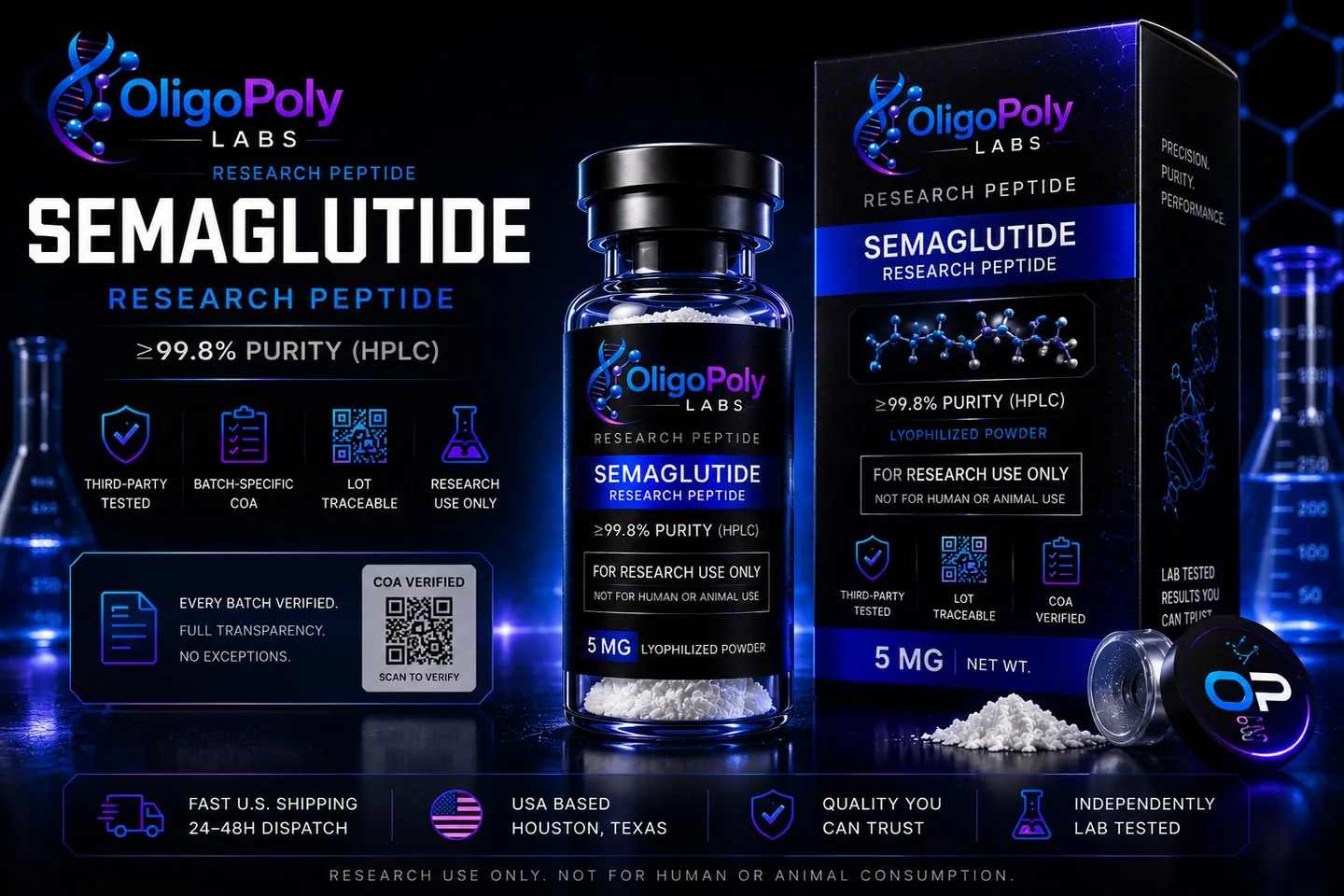
The following compounds represent the most widely studied research peptides in contemporary preclinical literature. Each is available from OligoPoly Laboratories for laboratory research use.




View all 42 research compounds → | Find your compound by research goal →
Quality Testing & Verification
The scientific validity of peptide research depends entirely on the quality of the compounds being studied. A peptide that is 90% pure contains 10% unknown impurities that may confound experimental results. A peptide with incorrect sequence identification invalidates every experiment in which it is used. Quality testing is not a marketing claim — it is a prerequisite for research integrity.
Storage & Handling
Maintaining peptide integrity from receipt to experiment requires documented storage temperature, moisture protection, and lot traceability. All OligoPoly Laboratories compounds are shipped as lyophilized (freeze-dried) powder in nitrogen-flushed, sealed vials — the most stable format for research peptide distribution.
| Storage Condition | Temperature | Duration | Notes |
|---|---|---|---|
| Short-term (working stock) | 2–8°C | Up to 3 months | Refrigerator; keep sealed and dry |
| Long-term (lyophilized) | −20°C | Up to 24 months | Standard freezer; parafilm-seal near volatiles |
| Transit / shipping | Room temperature | Stable for several days | Lyophilized format tolerates transit temperatures |
For non-procedural documentation about storage records and analytical verification, see:
- Peptide Storage & Handling Guide — Documentation and material-integrity overview
- Understanding HPLC Testing — How purity is measured and what chromatogram data means
Research Library
The OligoPoly Laboratories Research Library contains in-depth guides, comparison pages, mechanism deep-dives, and protocol documentation for researchers working with our compounds. Key resources:
- Retatrutide vs Tirzepatide — Triple vs dual receptor agonist comparison
- BPC-157 vs TB-500 Protocols — VEGF/NO vs actin-sequestration mechanisms
- Triple Agonist Peptide Guide — GLP-1/GIP/GCGR co-activation science
- GLP-1 Receptor Mechanism — Complete GLP-1R signaling reference
- Single vs Dual Agonist Peptides
- Metabolic Peptide Comparison Hub
- What Is Retatrutide?
- Metabolic Pathway Research Panels
→ Browse the full Research Library | → Compound Comparison Tool | → Peptide Finder
Research Use Only: All compounds, protocols, and scientific information on this page apply exclusively to laboratory and in vitro research contexts. None of the research peptides described are approved for human therapeutic, diagnostic, or veterinary use. OligoPoly Laboratories supplies research-grade compounds exclusively to qualified researchers.
Peptide Science — Complete Research Reference
Peptide Science — Research Peptides Explained
OligoPoly Laboratories is a USA-based research peptide supplier committed to providing the scientific community with high-purity, independently verified research compounds. This Peptide Science guide is designed as a master reference for researchers, procurement teams, and laboratory professionals who need to understand the foundational science behind peptide research compounds before selecting, ordering, and working with them.
What Is Peptide Science?
Peptide science encompasses the chemistry, biochemistry, pharmacology, and analytical methodology involved in researching, synthesizing, and characterizing peptide compounds. In the research context, peptide science covers: amino acid chemistry and peptide bond formation; solid-phase peptide synthesis and purification; receptor pharmacology and signal transduction; analytical verification methods (HPLC, LC-MS); stability, storage, and material-characterization science; and the application of peptide compounds as tool compounds in preclinical and in vitro research models. The GLP-1 receptor class, for example, represents one of the most pharmacologically studied peptide receptor systems in modern science.
Research Peptides Explained — How They Differ from Drugs
Research peptides are compounds supplied for laboratory investigation under research-use-only (RUO) classification. Unlike approved pharmaceuticals, research peptides have not completed the regulatory approval process for human therapeutic use. They are used in receptor pharmacology studies, signaling pathway research, preclinical in vitro experiments, and comparative compound studies. Their value as research tools lies in their high structural specificity — a well-characterized, high-purity research peptide with a verified sequence and purity provides a reproducible, reliable tool for probing specific biological pathways. This is why quality standards — HPLC purity, LC-MS identity, batch COA documentation — are so important in research peptide science.
Peptide Research Applications in 2025
Research peptides are used across multiple scientific disciplines. In metabolic research, GLP-1 receptor agonists and their dual- and triple-receptor variants are studied for incretin pathway pharmacology and receptor contribution analysis. In tissue repair research, BPC-157 and TB-500 are the two most-studied VEGF/actin pathway tools in preclinical literature. In cellular aging research, telomerase-activating peptides (Epitalon) and mitochondria-derived peptides (MOTS-c, SS-31) are key tool compounds. In neuroendocrine research, growth hormone secretagogues (ipamorelin, CJC-1295) enable mechanistic studies of the GH/IGF-1 axis. Each category represents an active research frontier with growing publication volume and compound demand.
Why Peptide Purity Matters in Research
Peptide purity directly affects the scientific validity of every experiment in which a compound is used. A 90% pure peptide contains 10% unknown impurities that may have independent biological activity, skew concentration-response curves, or confound mechanistic conclusions. At OligoPoly Laboratories, analytical results are published in the lot documentation where available — not as a marketing claim, but a documented requirement for every batch, verified by external accredited laboratories and available for review in the batch-specific COA documentation. Researchers who need to publish reproducible, credible data require compounds at this specification.
Research Use Only: All compounds described in this Peptide Science guide are strictly for laboratory and in vitro research purposes only. Not intended for human use, veterinary use, household use, or as a drug, food research material, cosmetic, or diagnostic/treatment agent. All purchases confirm the buyer is a qualified researcher operating under applicable institutional and regulatory guidelines.