

Quality Documentation
Find Your Batch Certificate
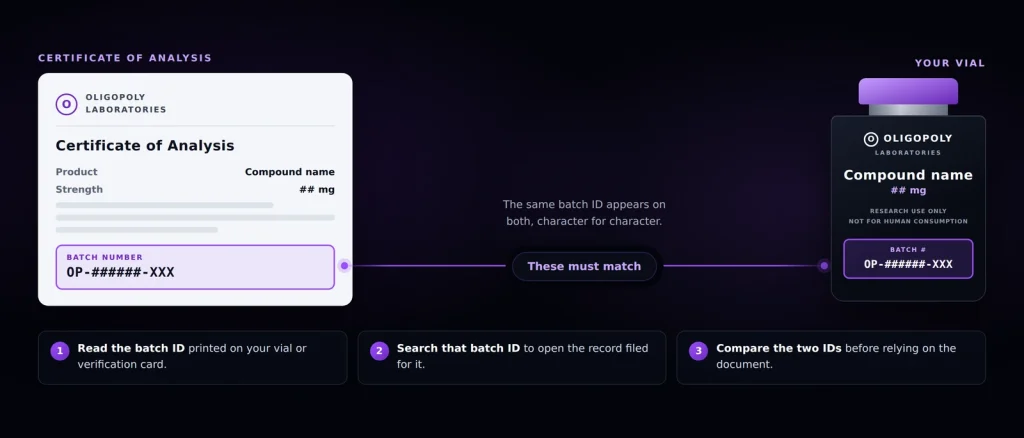
Enter the batch ID printed on your vial or verification card.
Use the complete batch ID, including letters and hyphens.
Batch IDs look likeOP–######–XXXtwo letters, six digits, then a short compound code, joined by hyphens
- Batch-specific recordsDocumentation is filed per batch, not per product family.
- Laboratory documentationCertificates and supporting analytical reports, where available.
- Research-use transparencyRecords are published as-is, with their issuer and date shown.
Search results
Enter the batch ID from your vial or verification card.
Browse the Certificate Library
7 records
Tirzepatide 10 mg
Batch ID: 20260609
Report date: August 26, 2026
Documents AvailableView Report for batch 20260609Semaglutide 5 mg
Batch ID: SGX-OL-2026-0811-S88
Report date: August 26, 2026
Documents AvailableView Report for batch SGX-OL-2026-0811-S88Selank 5 mg
Batch ID: OP-20260720-B001
Report date: August 26, 2026
Documents AvailableView Report for batch OP-20260720-B001Retatrutide 5 mg
Batch ID: P260628-L013
Report date: August 26, 2026
Documents AvailableView Report for batch P260628-L013NAD+ 500 mg
Batch ID: AYK20260418-NAD500
Report date: August 26, 2026
Documents AvailableView Report for batch AYK20260418-NAD500GHK-Cu 50 mg
Batch ID: SGX-OL-2026-0811-K99
Report date: August 26, 2026
Documents AvailableView Report for batch SGX-OL-2026-0811-K99KLOW 80mg
Batch ID: 20260805KL80
Report date: August 11, 2026
Documents AvailableView Report for batch 20260805KL80No records match that filter or batch ID.
How Verification Works
Step 1 — Match Your Batch
Enter the batch ID exactly as printed on your vial or verification card.
Step 2 — Open the Report
Review the available Certificate of Analysis and related laboratory documents.
Step 3 — Review the Details
Confirm the laboratory, report date, document validity, and matching batch ID.
Understanding Your Certificate
Identity
An identity section states which compound the tested material was found to be, and the method used to establish it. Read it alongside the batch ID so you know which material the finding describes.
Purity
A purity figure is a measurement produced by a stated method on a stated sample. It is meaningful only together with that method, the sample reference, and the batch it came from. A purity number quoted without them describes nothing in particular.
Peptide Content
Peptide content describes how much of the labelled compound the tested material contained, as distinct from purity. The two answer different questions and are reported separately.
Testing Methods
Certificates name the analytical method behind each line, commonly HPLC for purity and LC-MS for identity. Different methods answer different questions, so the method reference is part of the result, not a footnote.
Chromatography
A chromatogram is the raw output of a separation method: peaks plotted against retention time. Reading it depends on the method, sample preparation, detector and integration settings, all of which should be stated on the document that carries it.
Batch Numbers
The batch ID is the link between a physical vial and a document. If the ID on the certificate does not match the ID on your vial character for character, the document describes a different batch and does not apply to what you are holding.
Document Dates
A report date fixes when the analysis was reported. Records are kept after they are replaced rather than deleted, marked Archived or Superseded, so an older document stays available for the batch it describes.
Laboratory Information
Each record names the party that issued it. An issuer may be an outside analytical laboratory or the supplier of the material. These are not equivalent, so the issuer is shown as recorded and is never described as independent unless the document itself establishes that.
More detail on documentation practice: Quality Standards and Research Library.
For Research Use Only — Not for Human Consumption
Products and supporting documentation are intended solely for laboratory research use. They are not intended for diagnostic, therapeutic, or human-use procedures.