
GLP-1 Monotherapy vs Dual Agonist | Research Comparison
Semaglutide vs Tirzepatide
A mechanistic research comparison of semaglutide (selective GLP-1R agonist) and tirzepatide (GLP-1R/GIPR dual agonist). What GIP receptor co-activation adds at the molecular level and how it shifts experimental outcomes.
For pure GLP-1R pharmacology research, semaglutide is the clean single-receptor tool. For studying incretin synergy and GIP co-activation effects, tirzepatide is the necessary dual-agonist control. Both are essential metabolic research compounds — the research question determines which compound belongs in your protocol.
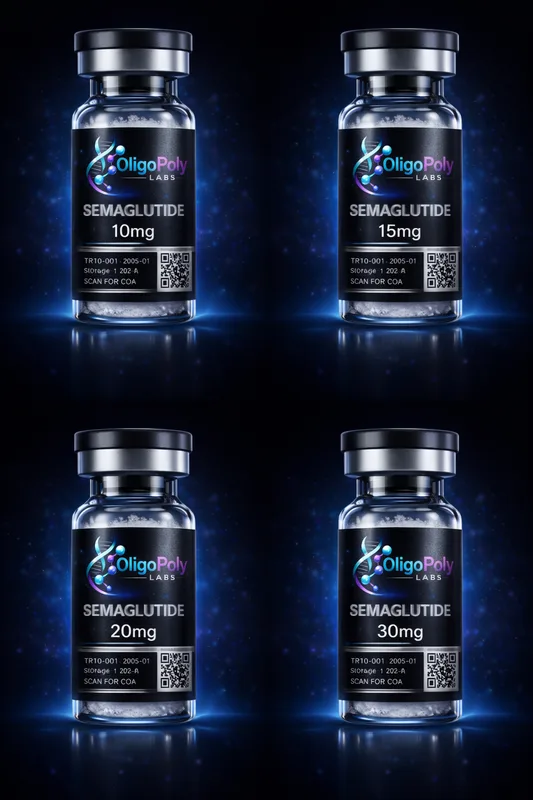
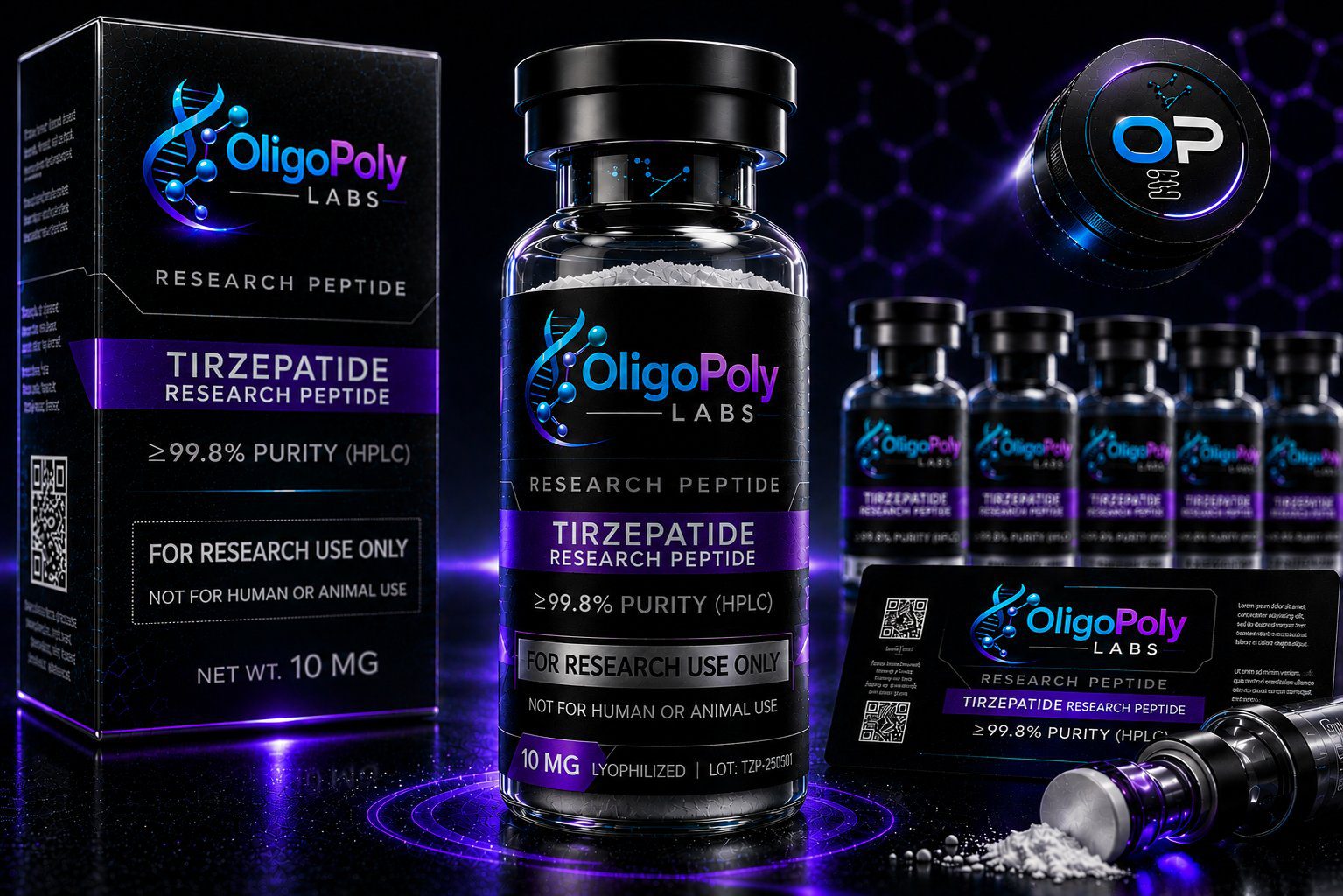
| Parameter | Semaglutide | Tirzepatide |
|---|---|---|
| Receptor Targets | GLP-1R only | GLP-1R + GIPR |
| Agonist Class | Single (1st gen) | Dual (2nd gen) |
| Half-Life | ~7 days | ~5 days |
| Fatty Acid | C18 (monoacid) | C20 diacid |
| MW | 4,113 Da | 4,814 Da |
| GLP-1R Activity | Primary | Primary |
| GIPR Activity | None | Co-agonist |
| GCGR Activity | None | None |
| Albumin Binding | Reversible (C18) | Reversible (C20) |
| Price | $49 | $59 |
| HPLC Purity | ≥99.8% | ≥99.8% |
| COA | Batch-specific | Batch-specific |
Receptor Mechanism Comparison
Semaglutide and tirzepatide share GLP-1R activation as their primary mechanism — but at the molecular level, this is where their similarity ends. Semaglutide is a pure GLP-1R agonist: its entire pharmacological profile flows from GLP-1R-mediated Gαs activation, cAMP elevation, PKA signaling, and downstream CREB phosphorylation in target tissues. This selectivity is its research value — it isolates GLP-1R contribution in any experimental system.
Tirzepatide adds GIPR (glucose-dependent insulinotropic polypeptide receptor) co-activation. GIPR is also a class B GPCR expressed on pancreatic beta cells, adipocytes, CNS neurons, and osteoblasts — with partially overlapping but distinct signaling from GLP-1R. GIPR couples to Gαs and elevates cAMP, but the downstream effectors differ: GIPR has stronger coupling to adipose tissue lipolysis and lipid storage, while GLP-1R has stronger coupling to satiety circuit suppression and gastric emptying inhibition.
Key mechanistic distinction: When semaglutide and tirzepatide are compared head-to-head in preclinical models, the incremental effect seen with tirzepatide above semaglutide quantifies the GIPR receptor contribution in that specific tissue or assay. This is why both compounds are needed as controls in rigorous incretin research — not one or the other.
Pharmacokinetics & Half-Life
Both compounds use fatty acid conjugation for albumin binding and plasma half-life extension — but different chain architectures produce different PK profiles. Semaglutide uses a C18 monoacid linker that produces ~7-day plasma half-life in published clinical PK data. Tirzepatide uses a C20 fatty diacid moiety that produces ~5-day half-life — slightly shorter, reflecting different albumin affinity kinetics.
For research protocol design, the practical implication is dosing interval alignment. Semaglutide supports weekly dosing paradigms with stable trough concentrations. Tirzepatide at 5-day half-life can also support weekly dosing while maintaining effective receptor occupancy across the dosing interval. In vitro studies are less affected — in cell culture, both compounds exhibit comparable receptor occupancy kinetics when equimolar concentrations are applied.
For half-life reference data across all GLP-1 class peptides, see our Peptide Half-Life Research guide.
Isolating GIP Receptor Contribution
One of the most valuable experimental applications of the semaglutide/tirzepatide comparison is mechanistic dissection of GIP receptor contribution. Because both compounds are GLP-1R agonists with similar potency at that receptor, the delta between semaglutide and tirzepatide outcomes in a given assay represents the additive GIPR signal — assuming equimolar dosing and equivalent GLP-1R occupancy.
Published Phase 2/3 clinical data shows tirzepatide achieving approximately 20–22% body weight reduction at highest doses versus 12–15% for semaglutide at equivalent dosing intensity. The ~7–9% differential is the subject of significant mechanistic research, with adipose GIPR signaling (particularly via cAMP/PKA suppression of lipogenesis) implicated as a key pathway.
Suggested Experimental Design
- Run semaglutide and tirzepatide in parallel at equimolar concentrations in the same assay system
- The tirzepatide — semaglutide delta isolates the GIPR-specific contribution
- Add a GIPR-selective agonist or antagonist as a third condition to validate attribution
- For in vivo designs, allow ≥5 half-lives washout between crossover arms
Published Efficacy Data
The SUSTAIN program (semaglutide) and SURPASS program (tirzepatide) provide the primary published efficacy and safety datasets for these compounds. Key published findings from peer-reviewed literature:
| Metric | Semaglutide (2.4mg/wk) | Tirzepatide (15mg/wk) |
|---|---|---|
| Body Weight Reduction | ~14.9% (STEP 1) | ~20.9% (SURMOUNT-1) |
| HbA1c Reduction | ~1.6% | ~2.0–2.3% |
| Responders >15% loss | ~37% | ~57% |
| GI Adverse Events | ~40% | ~40-44% |
These are clinical endpoints in human subjects — not direct predictors of in vitro or preclinical outcomes. They do, however, validate the physiological relevance of the receptor mechanisms studied in preclinical research using these compounds.
Compound Selection for Research
Choose Semaglutide when your research requires: a clean GLP-1R monotherapy baseline, the longest available half-life (~7 days), or when GIP co-activation would confound your assay readout.
Choose Tirzepatide when your research requires: studying GLP-1R/GIPR co-activation synergy, modelling dual incretin mechanisms, or directly comparing second-generation to first-generation receptor engagement.
Use both in parallel when your research goal is mechanistic dissection — the experimental delta between the two compounds is, in many designs, the most scientifically valuable data point.
Also consider Retatrutide ($99) as the third-generation comparator — adding GCGR to the GLP-1R/GIPR axis for complete triple-agonist mechanistic analysis. See our Retatrutide vs Tirzepatide guide.
Research Use Only: All compounds are strictly for laboratory and in vitro research. Not for human use, veterinary use, or any diagnostic or treatment purpose. OligoPoly Labs supplies research-grade peptides exclusively to qualified researchers.
OligoPoly Labs — Houston TX · Research Use Only
Semaglutide vs Tirzepatide — Research Comparison
Semaglutide and tirzepatide represent the first and second generations of GLP-1 receptor agonist research peptides. Semaglutide is a selective GLP-1R agonist with ~7-day plasma half-life via C18 fatty acid albumin binding. Tirzepatide adds GIPR co-activation via a C20 diacid moiety, producing ~5-day half-life and dual incretin mechanism. OligoPoly Labs supplies both compounds at ≥99.8% HPLC purity with batch-specific COA documentation, verified by independent accredited third-party laboratories. Ships from Houston TX.
Research Applications
Semaglutide (ID 47, $49) and tirzepatide (ID 39, $59) are most valuable when used in parallel — semaglutide establishes the GLP-1R baseline, tirzepatide adds the GIPR contribution. The delta between their experimental outcomes quantifies GIP receptor-specific effects in your assay system. See our compound comparison tool for side-by-side data and our metabolic comparison hub for full GLP-1 class analysis.
Research Use Only. Not for human use, veterinary use, or diagnostic/treatment purposes.
Research Compounds Referenced in This Guide
For Research Use Only · Third-Party Tested · COA Verified · Ships from Houston TX